Kruja
A castle on a steep shelf above the Ishëm valley, with a bazaar street below it that still trades from the workshops built into its arcade.
- Entry
- E.3
- Where
- Mountain shelf above the plain
- Period
- Ottoman, on a fifteenth-century site
- Section
- Bazaar Towns
01The layout
Krujë sits on a mountain ledge of the Kruja range northwest of Tirana, at an altitude where the terrain itself determined the defensive line. The castle occupies the highest point of the shelf; below it, pressed against the slope, a single Ottoman bazaar street runs along the contour. The arrangement is not accidental — a defended height, a market at its foot, and a road connecting both to the plain below: this is the standard vertical grammar of the region.
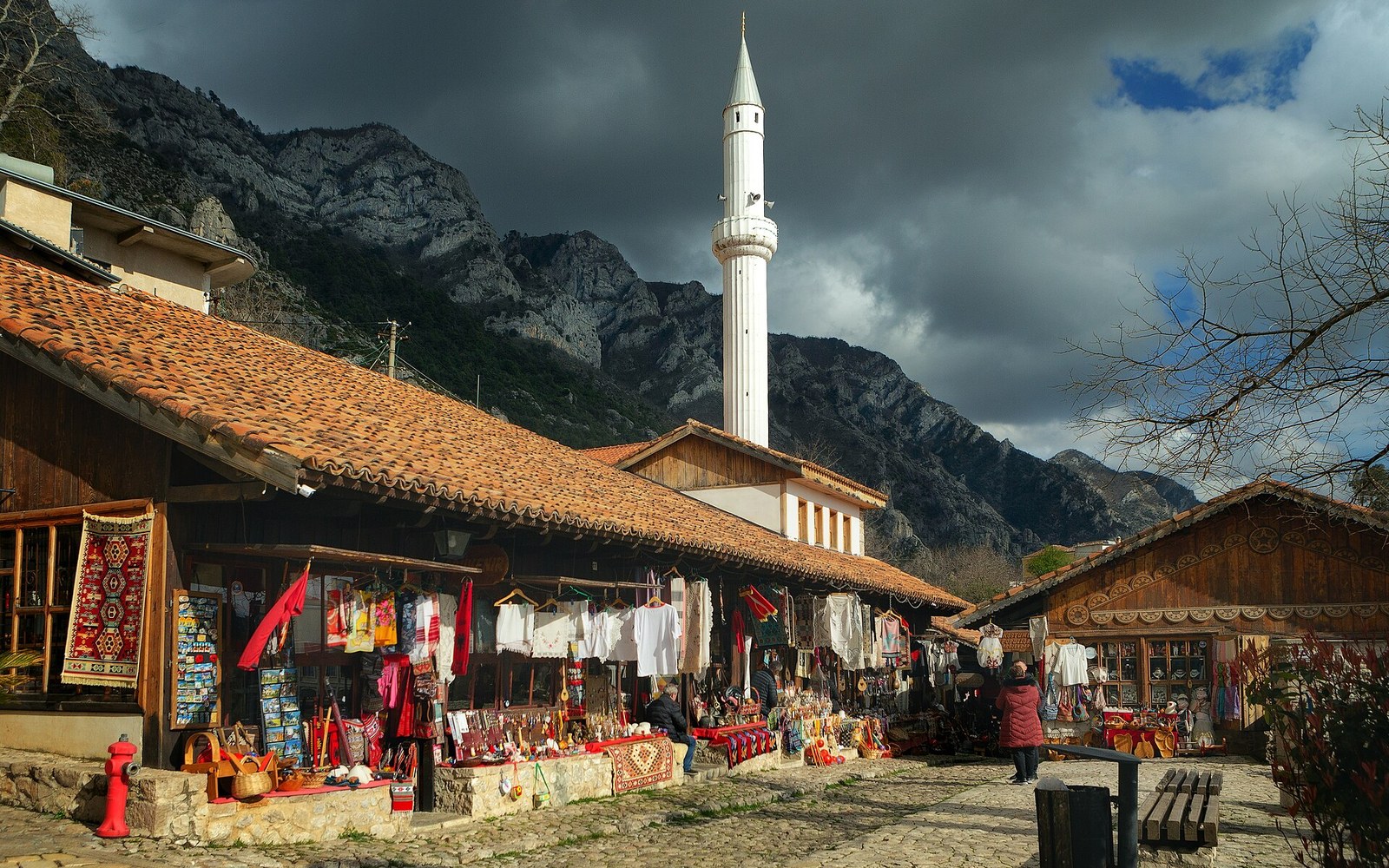
The bazaar street is a short run of lock-up workshops built in continuous arcade, the pitched wooden canopies projecting over the lane to shade the workers and the goods. The workshops are stone-based, timber-fronted, each unit roughly the same width — the module of a single trade. Copper-beating, leatherwork and textile trades occupied this street under the Ottomans, and several of those trades are still practised here by adult craftspeople working in the same footprint. The street is not a reconstruction: it continued in use through the twentieth century, which is the reason it survived it.
The two layers — the resistance-era castle and the working Ottoman market — occupy the same ridge without contradiction.
The castle above has earlier foundations — there was a settlement on this shelf through the medieval period — but the structure visible today has been reworked and repaired at different periods. Between castle and bazaar, the ground is steep enough that the two exist in effectively different climatic zones: the market lane is sheltered; the castle plateau is exposed to wind off the range.
The name Gjergj Kastrioti — known in the West as Skanderbeg — is attached to this place in every account of the fifteenth century, and the castle contains a museum to him. The historical substance is real: Krujë was a significant stronghold during the Albanian resistance to Ottoman expansion in the mid-fifteenth century, and it did eventually fall to Ottoman control. What Ottoman building remains here, including the bazaar, came after that period. The two layers — the resistance-era castle and the working Ottoman market — occupy the same ridge without contradiction.
The street's value is not symbolic. It is a clear physical example of the Ottoman bazaar type as it actually functioned: a single row, a repeated unit, a covered frontage, and an economic life persistent enough to keep the fabric standing.
- Mid-fifteenth centuryKrujë as an Albanian stronghold during resistance to Ottoman expansion
- Post-fallOttoman market street laid out below the castle, establishing the bazaar line still visible today
- Twentieth centurybazaar remained in working use; this continuity preserved the fabric
- Lock-up workshop units of equal width
- the single-trade module in physical form
- Projecting timber canopies over the lane
- shade structure integral to the building type, not a later addition
- Stone base, timber front
- standard Ottoman bazaar construction in this region